When you're planning a renovation or new furniture, the quote from your carpenter or contractor can look very different depending on one decision: which plywood goes inside. On paper, the cheaper board always wins. It saves you money today and quietly starts costing you tomorrow.
This article is about the difference between price and costs a concept finance people call total cost of ownership. And it's something almost nobody explains to homeowners when they're choosing materials.
The Two Prices of Every Renovation
Every material you buy has two price tags:
- The purchase price
- what you pay at the store today.
- The lifecycle cost
- what the material actually costs you over its working life, including repairs, maintenance, and early replacement.
Cheap plywood wins on the first. It almost always loses on the second and often by a wide margin.
To see why, let's walk through a real-world example.
A Simple Example: The Bedroom Wardrobe
Suppose you're building a 3-door wardrobe. Your carpenter offers two options:
|
Budget Board |
Premium BWR Plywood |
|
|
Board cost (approx.) |
NPR 35,000 |
NPR 52,000 |
|
Laminate & adhesive |
NPR 18,000 |
NPR 18,000 |
|
Labor |
NPR 15,000 |
NPR 15,000 |
|
Total today |
NPR 68,000 |
NPR 85,000 |
The budget option saves you NPR 17,000 roughly 20%. For most families in Nepal, that's a meaningful saving, and it's completely understandable to take it.
But here's what typically happens over the next five years.
Year 1–2: Everything Looks Fine
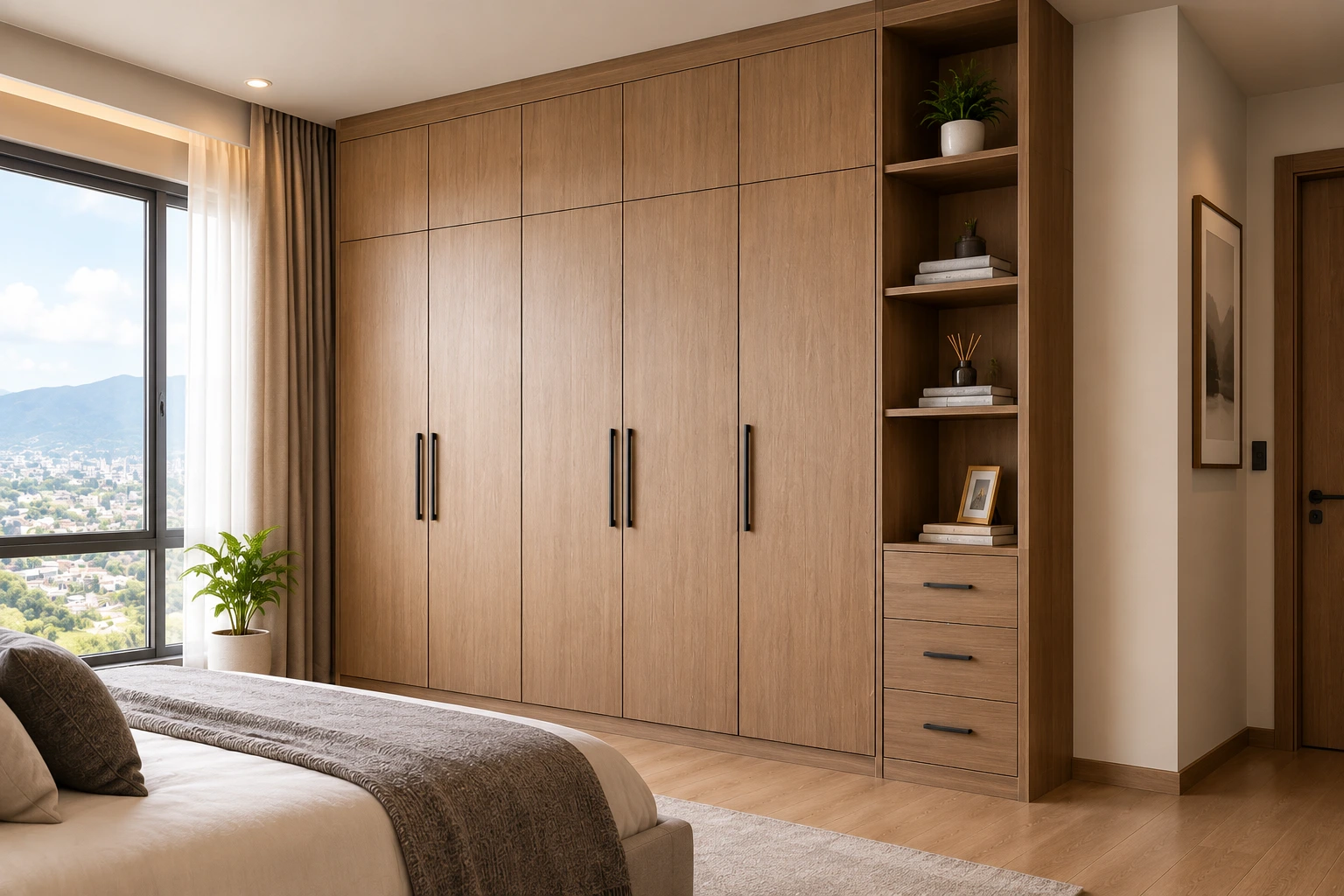
The wardrobe looks identical to the premium one. This is the trap. Delamination, warping and joint failure don't announce themselves early they develop quietly inside the board.
Year 2–3: The First Warning Signs
- Screw joints loosen. Low-density boards have weak screw-holding strength. Hinges start sagging; doors no longer align. Your carpenter tightens them twice, but the holes have worn and the screws won't grip anymore.
- Warping appears. Cheap boards use uneven core layers and inconsistent glue. In Nepal's humid monsoon months (June–September, when indoor humidity regularly climbs above 70%), the board absorbs moisture unevenly and the doors begin to twist.
- Swelling at the edges. Especially near bathrooms and kitchens, moisture creeps into exposed edges. The laminate starts lifting at the corners.
Year 4–5: Replacement, Not Repair
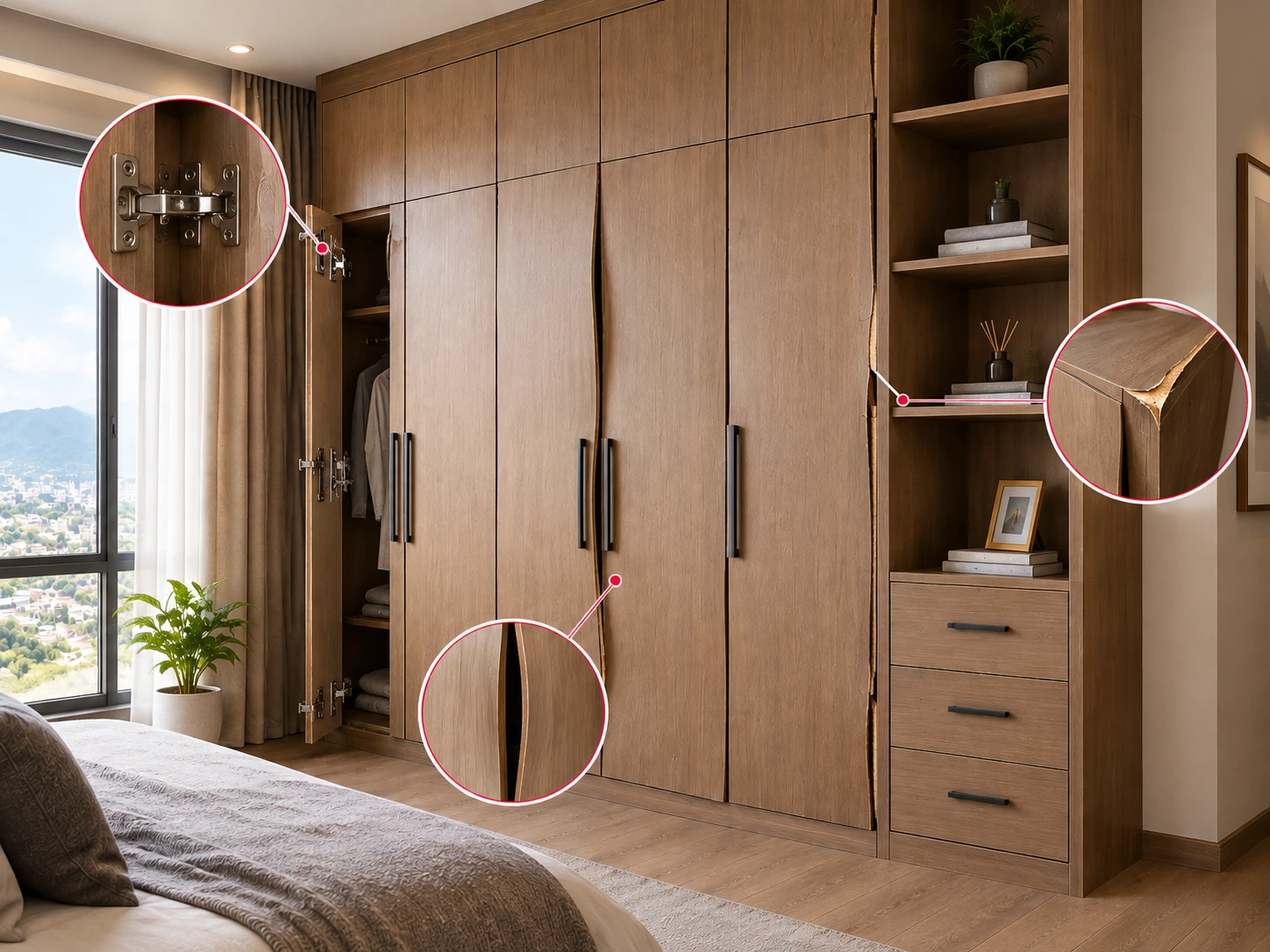
Now the problems are structural:
Shelves sag under load (books, folded clothes, stored items).
Delamination spreads — the laminate separates from the core in large patches.
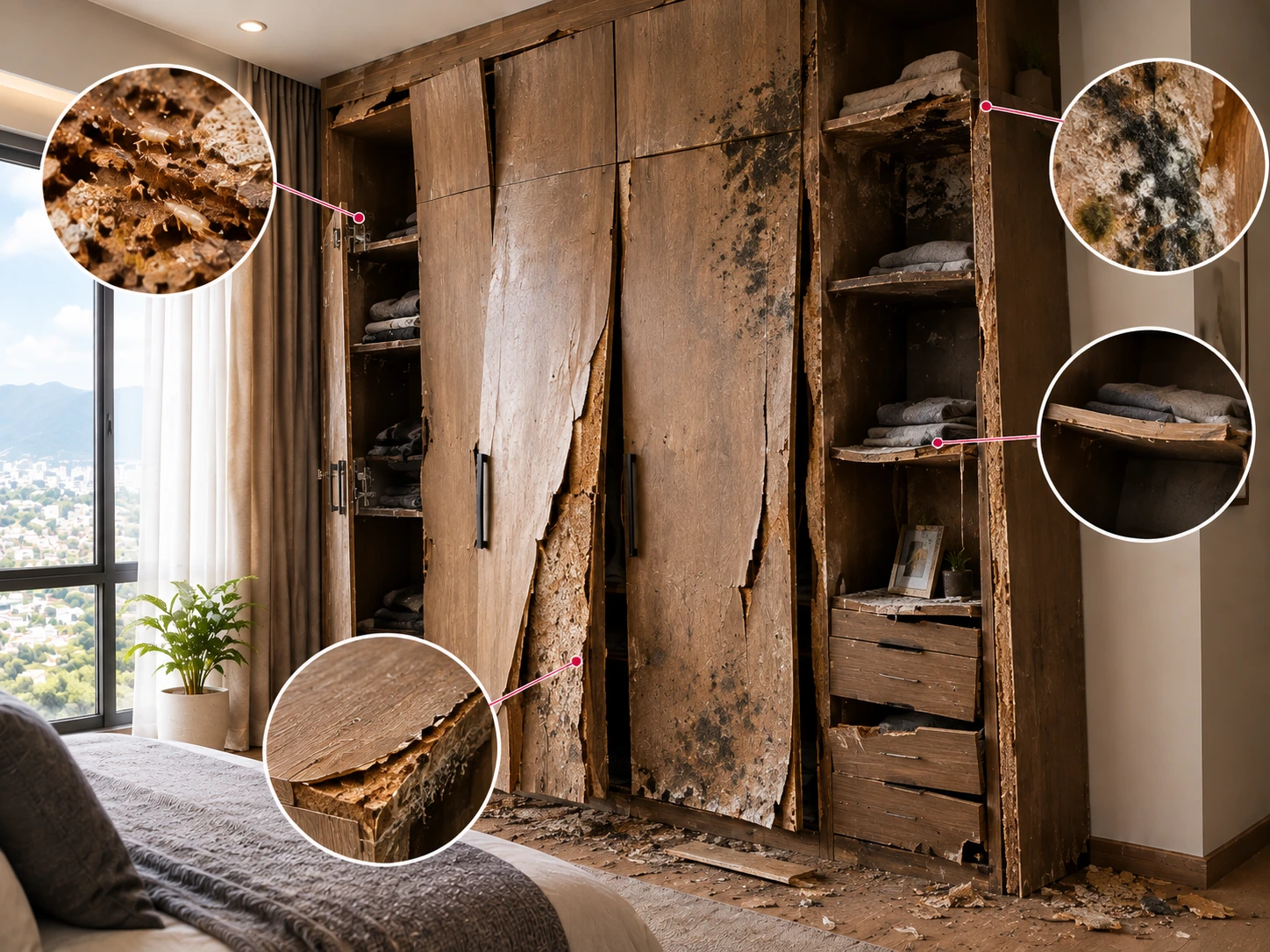
In the worst cases, termites and fungus find the board. Budget boards with low-quality cores and inadequate treatment are far more vulnerable, and in Nepal's climate this is not a rare scenario.
At this point, the wardrobe isn't repairable it's rebuildable.
|
Budget Board (Year 5) |
Premium Board (Year 5) |
|
|
Original build |
NPR 68,000 |
NPR 85,000 |
|
Repairs & hardware |
~NPR 6,000 |
~NPR 0–1,000 |
|
Rebuild (labor + board + laminate) |
~NPR 68,000 |
— |
|
5-year total |
~NPR 142,000 |
~NPR 85,000–86,000 |
|
Cost per year |
~NPR 28,400/year |
~NPR 17,000/year |
The "cheap" wardrobe ended up costing 60% more and you lived with five years of frustration in between. (Note: figures are illustrative; actual prices vary by brand, grade and design. Visit our showroom for current rates.)
Why Cheap Boards Fail: The 4 Hidden Weaknesses
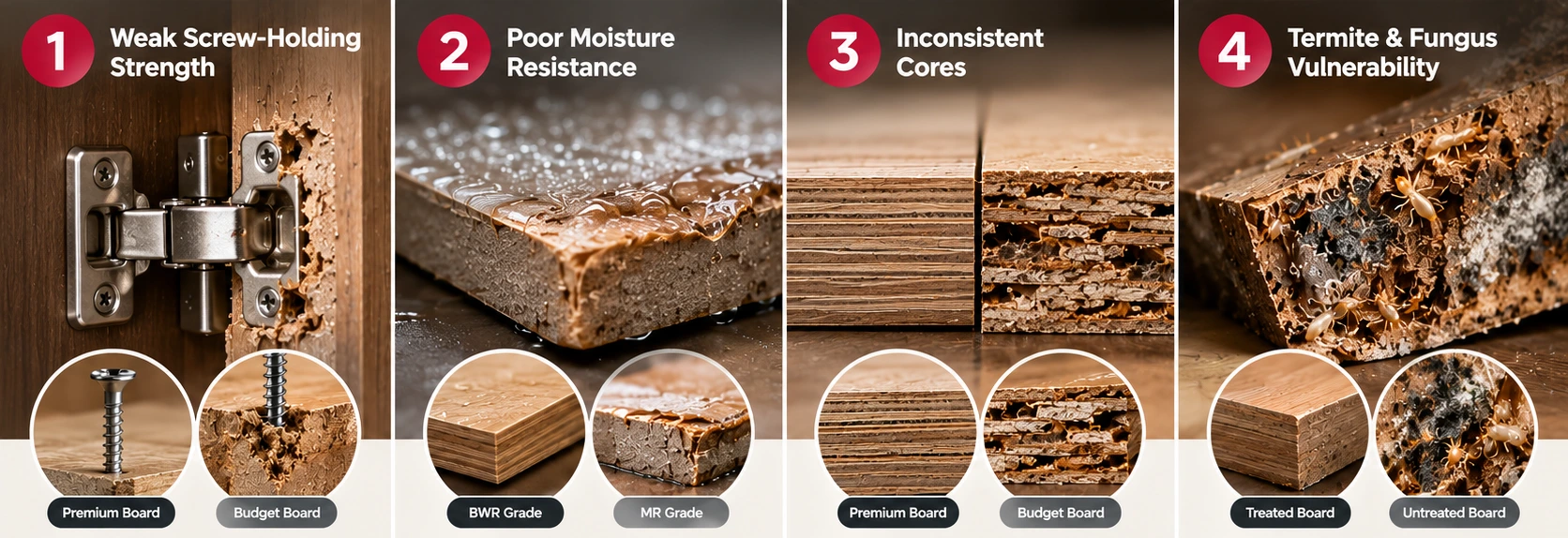
1. Weak Screw-Holding Strength
Furniture lives and dies on its joints. Premium boards like Shikhar Plywood or Action Tesa HDHMR are denser and more uniform, so screws grip firmly and stay gripped. Budget boards crush under repeated stress the #1 reason doors and drawers fail.
2. Poor Moisture Resistance
A wardrobe or kitchen unit doesn't need to sit in water to fail Nepal's monsoon humidity alone is enough for boards with weak glue lines and low-grade cores. BWR-grade (Boiling Water Resistant) boards are engineered for exactly this environment. MR-grade (Moisture Resistant) boards are cheaper, but the name says it honestly: they resist moisture, they don't withstand it.
3. Inconsistent Cores
Cut a premium board and a budget board side by side. The premium core is uniform, with minimal gaps and overlapping layers. The budget core often has voids, overlaps and patches — weak points where delamination and breakage begin.
4. Termite & Fungus Vulnerability
Properly treated boards are far less attractive to termites a genuine and costly problem in many parts of Nepal, particularly in ground-floor and older buildings.
The Finance Lens: What You're Really Buying
Think of premium plywood the way you'd think of any durable asset. You pay more upfront for:
- A longer useful life:
- 15–20 years vs 4–6 years
- Lower maintenance:
- Fewer carpenter visits, fewer hardware replacements
- Resale value:
- Fitted furniture quality matters when selling or renting a home
- Peace of mind:
- No monsoon anxiety about swelling doors
In finance terms, the premium board has a lower cost per year of service and a lower total cost of ownership. The budget board is the depreciating asset that fails before it's paid for itself.
"But My Budget Is Tight" A Practical Middle Path
If the full premium route isn't affordable right now, prioritize rather than compromise everywhere:
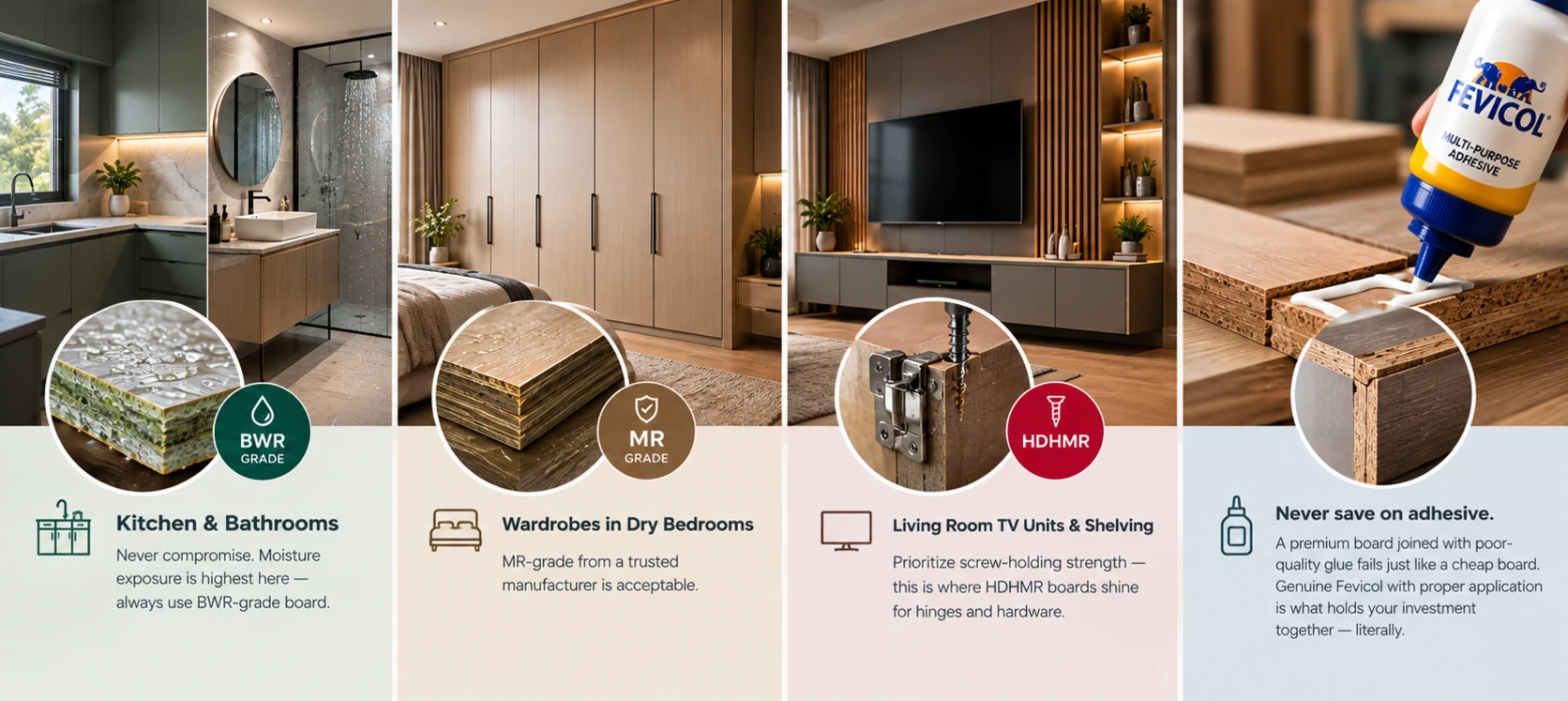
- Kitchen & bathrooms: Never compromise. Moisture exposure is highest here — always use BWR-grade board.
- Wardrobes in dry bedrooms: MR-grade from a trusted manufacturer is acceptable.
- Living room TV units & shelving: Prioritize screw-holding strength — this is where HDHMR boards shine for hinges and hardware.
- Never save on adhesive. A premium board joined with poor-quality glue fails just like a cheap board. Genuine Fevicol with proper application is what holds your investment together — literally.
And one more thing that's free: buy from an authorized source. The plywood market in Nepal has its share of underweight sheets, rebranded grades and counterfeit stock. A board labelled BWR that isn't actually BWR will fail exactly like the budget option — at a premium price.
The Bottom Line
A renovation is one of the largest purchases a Nepali family makes, and unlike a car or a phone, you can't resell it when you're done. You live inside your investment every single day.
Cheap plywood isn't a saving. It's a loan you take out against year four — and the interest is paid in repairs, rebuilds and frustration.
Pay for the board once or pay for the furniture twice.
At Carpenters Stop, we stock genuine Shikhar Ply, HiTech Ply, Space Ply and Action Tesa boards with physical samples you can inspect before you buy. Visit our showrooms in Gyaneshwor or Pepsicola, or share your project details with our team and we'll help you choose the right grade for your budget and your space.
Frequently asked questions
Yes, the key is to compare total cost over the furniture’s lifetime, not just the initial purchase price. A higher-quality board can reduce repairs, hardware replacement and premature rebuilding.
For areas exposed to higher moisture, such as kitchens and bathrooms, the blog recommends BWR-grade plywood rather than MR-grade boards.
Buy from an authorized and trusted source, check the board physically, and verify its grade and specifications. It is to be noted that the market can have underweight sheets, rebranded grades and counterfeit stock.
It's a genuine concern, not a gimmick. Termites are a
serious problem across Nepal, especially in ground-floor units, older
buildings, and homes near gardens or untreated soil. If your furniture is going
into a ground-floor or older property, insist on termite-treated, branded board the treatment cost is a fraction of a termite repair or rebuild.
Treat that as a red flag unless he can explain where
it's fine. MR (Moisture Resistant) survives normal indoor humidity but will
warp and delaminate with sustained moisture exposure exactly what Nepal's
June–September monsoon delivers, when indoor humidity regularly exceeds 70%. MR
is acceptable for dry bedrooms and living areas; kitchens, bathrooms, and
anything near plumbing should always be BWR-grade. A contractor recommending
one grade for everything is usually optimizing for his quote, not your
furniture's lifespan.
Ask any dealer to cut or show you a core sample a
genuine premium board has a uniform, gap-free core, while budget boards show
voids and patchy layers. At Carpenters Stop, you can inspect physical samples
of genuine Shikhar Ply, HiTech Ply, Green Ply, and Action Tesa boards before
committing. Visit our showrooms in Gyaneshwor or Pepsicola, or share
your project details with our team and we'll recommend the right grade for your
space and budget.