Choosing a laminate in Nepal is not only about colour or woodgrain. Thickness affects how the sheet feels during handling, how easily it follows small imperfections in the base board, and where the product is normally positioned in the market. It also affects price. However, a thicker laminate is not automatically more scratch-resistant, waterproof or colour-fast. Those properties depend on the product grade, surface layer, resin system, testing, substrate, adhesive and installation quality.
This practical guide compares 0.62 mm, 0.70 mm, 0.80 mm and 1 mm laminate sheets for Nepali homes, offices and commercial interiors. It also explains the indicative price difference for a standard 8 x 4 ft sheet and helps you choose the right thickness for wardrobes, kitchen shutters, doors, TV units and internal cabinet surfaces.

Quick answer: Which laminate thickness is best?
"For most residential furniture in Nepal, 0.80 mm offers the best balance of price, sheet body and finish. For kitchen shutters, doors, frequently handled furniture and premium projects, 1 mm is usually the safer long-term choice when the correct HPL grade is selected. Use 0.70 mm mainly for liners, backers and inner cabinet surfaces. Choose 0.62 mm only for budget conscious, light use or low-touch vertical applications where the substrate is very flat."
Table 1. Quick laminate thickness and price comparison
|
Thickness |
Indicative start |
NPR / sq. ft. |
Best suited for |
Overall choice |
|
0.62 mm |
NPR 700+ |
NPR 21.86+ |
Back panels and low-touch vertical surfaces |
Lowest-cost, light duty option |
|
0.70 mm |
NPR 800+ |
NPR 25 |
Wardrobe/cabinet interiors, liners and backers |
Affordable liner / interior choice |
|
0.80 mm |
NPR 1,300+ |
NPR 40.62 |
Wardrobes, TV units, wall panels and general furniture |
Best overall value for many home interiors |
|
1 mm |
NPR 3,000+ |
NPR 93.75 |
Kitchen shutters, doors and premium high-touch furniture |
Premium choice for frequent use |
What does laminate thickness actually change?
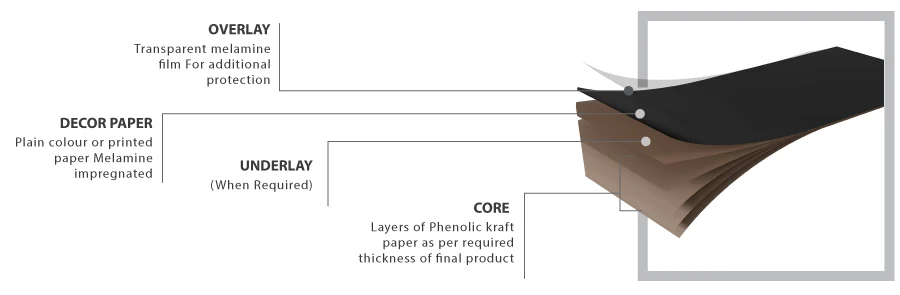
Decorative high-pressure laminate, or HPL, is a surfacing sheet that must be bonded to a suitable board such as plywood, MDF, particleboard or another approved substrate. In conventional HPL construction, kraft papers in the core are commonly treated with phenolic resin, while the decorative surface paper is treated with a melamine-based resin. Manufacturers may add an overlay or a specialized coating for extra surface performance, but this is product-specific and cannot be confirmed from thickness alone.
Increasing thickness generally adds more sheet body and makes the laminate less delicate during transport, cutting and bonding. A thicker sheet can also hide very small substrate irregularities better, although no laminate can correct a badly prepared board. Scratch resistance, stain resistance, colour fastness, heat resistance and formaldehyde performance must be checked in the manufacturer's technical data or relevant test standard.
Technical Reality Check
- Resin system: Conventional HPL generally uses phenolic-resin-treated kraft paper in the core and a melamine-treated decorative surface. Resin is not assigned by thickness.
- Overlay: An overlay or special coating is product-specific and is not guaranteed by nominal thickness.
- Colour fastness: This depends on the decor paper, surface resin or coating, grade and test data not thickness alone.
- Lifespan: No honest, fixed service life can be inferred from thickness. Use, substrate, bonding, edges and maintenance all matter.
Laminate price comparison in Nepal
Based on the indicative starting figures supplied for this article, a standard 8 x 4 ft sheet may start at about NPR 700+ for 0.62 mm, NPR 800+ for 0.70 mm, NPR 1,300+ for 0.80 mm and NPR 3,000+ for 1 mm. This works out to roughly NPR 25, NPR 30, NPR 41 and NPR 94 per sq. ft. respectively.
Price note
These are indicative starting figures, not a fixed market price list. Laminate prices in Nepal change with the brand, design, finish, collection, sheet size, special performance, VAT, stock level and dealer offer. The comparison is also not perfectly like-for-like when one thickness is a basic liner range and another belongs to a premium HPL collection. Confirm the latest quotation from Carpenters Stop before publishing or ordering.
0.62 mm Laminate: Lowest-cost option for light use
A 0.62 mm Laminate has the least body among the four options. It is flexible and economical, but it needs careful handling and a smooth, properly prepared substrate. Small waves, joints or glue inconsistencies in the base board can become more noticeable after pressing.
It is best considered for low touch vertical areas, temporary or budget furniture, back panels and internal surfaces where appearance and duty level are modest. It is not the first choice for busy kitchen shutters, frequently handled doors or exposed horizontal surfaces. Always confirm that the particular product is intended for the planned application.
0.70 mm Laminate: Practical for liners and interiors
A 0.70 mm Laminate sheet offers slightly more body than 0.62 mm and is commonly positioned in liner, backer and inner-surface collections. Official Merino information, for example, describes 0.7 mm and 0.8 mm Merinoliner products as suitable for liner, backer and inner-surface applications.
This thickness is a sensible choice for the inside of wardrobes, cabinets, drawers and balancing applications when matched to the panel design. It can be used on visible vertical furniture only when the manufacturer's grade and test data support that use. Do not assume every 0.70 mm product has the same performance.
0.80 mm Laminate: Best overall value for many homes
For many Nepali homeowners and furniture makers, 0.80 mm is the value sweet spot. It has enough body for easier handling and a clean finish while remaining more affordable than most premium 1 mm collections. It suits wardrobes, TV units, study tables, wall panels, office furniture and other regular residential vertical applications when correctly bonded.
Merino Calplus is an example of a 0.8 mm decorative laminate collection. When comparing Merino laminates or any other brand, check the exact collection rather than judging only by the nominal thickness. For a kitchen, 0.80 mm can work on vertical shutters if the product grade, substrate and fabrication are suitable, but 1 mm provides more confidence for premium and high use work.
1 mm Laminate: Premium choice for frequent use
A 1 mm Laminate has the fullest sheet body in this comparison and is widely used for premium visible surfaces. It is usually easier to handle without excessive flex, gives a substantial finished feel, and is a strong choice for kitchen shutters, doors, premium wardrobes, reception furniture and other frequently handled vertical surfaces.
For horizontal worktops or counters, thickness alone is not enough: select an HPL grade specifically approved for horizontal use and follow the manufacturer's fabrication instructions. A 1 mm sheet also costs more because it may combine extra material with a premium design, finish, overlay, special coating, certification or brand position. The price jump is therefore not caused by the additional 0.20 mm alone.
Which Laminate is best for each application in Nepal?
- Wardrobe and cabinet interiors: 0.70 mm liner is usually the practical value choice; 0.62 mm may suit very light-use budget work.
- Wardrobe shutters, TV units and regular home furniture: 0.80 mm offers the strongest price to performance balance for many projects.
- Kitchen shutters, main visible doors and high-touch furniture: Choose a tested 1 mm HPL where budget allows.
- Commercial counters and heavy horizontal use: Choose the correct horizontal grade or specialized laminate; do not rely on thickness alone.
Why is there such a big price difference?
- Material and thickness: A thicker HPL normally contains more core material, but this is only one cost driver.
- Brand and quality control: Consistent thickness, flatness, colour matching and documented testing add value.
- Finish and design: High gloss, super matte, synchronous, deep texture, metallic, digital and specialty finishes cost more than basic suede or matte designs.
- Surface performance: Overlays, anti-fingerprint coatings, abrasion resistance, fire-retardant or chemical-resistant grades can increase the price.
- Sheet size and availability: Larger sizes, imported stock, low-volume colours and fast delivery can change the final rate.
- Distribution, VAT and dealer offer: Always compare the same brand, design, finish, size, grade and tax basis before deciding.
Important for Nepal's monsoon and changing humidity:
A laminate surface can resist normal moisture and cleaning, but a finished furniture panel is not automatically waterproof. Water usually enters through unsealed edges, joints, cut-outs or damaged adhesive and then affects the plywood, MDF or particleboard below. In moisture prone Nepali rooms, select a suitable substrate and adhesive, seal all edges, protect sink and plumbing cut outs, and keep standing water away.
Before fabrication, allow the laminate, substrate and adhesive to acclimatize together in conditions close to the final room. Merino's technical guide recommends preconditioning the materials and highlights 48 hours as a general reference, while noting that actual time depends on local temperature and humidity. Balanced construction on both faces also helps reduce panel warping.
How to compare brands and catalogues:
The supplied search data shows the highest relative interest in "Merino laminates", followed by searches such as "Greenlam laminates" and "Century laminates"; several catalogue and competitor-brand queries are also rising. Use a Merino laminates catalogue or Merino laminates catalogue PDF to shortlist colours, but make the final decision from the physical sample and technical data. The same rule applies when comparing Greenlam, Century, Kajaria, Advance, Kridha, Delta, Royal Touch, Royal Crown or Croma laminates. Product names and thickness labels are not a substitute for grade, test results and warranty terms.
Laminate buying checklist:
- Confirm the exact nominal thickness, collection, design number, finish and 8 x 4 ft or other sheet size.
- Ask whether the sheet is intended for liner, vertical-grade, horizontal-grade, postforming or specialized use.
- Check the technical sheet for surface wear, scratch, stain, heat, impact, colour and formaldehyde performance.
- Compare prices only after matching the same brand, collection, finish, size, tax basis and dealer service.
- Inspect a physical sample under the actual room lighting and confirm stock before approving a large project.
Frequently asked questions:
Not automatically. A 1 mm sheet normally has more body and may handle fabrication and frequent use better, but surface durability depends on the grade, decorative surface, overlay or coating, resin cure and test performance. A well-made 0.80 mm HPL can outperform a poorly made 1 mm sheet.
Decorative HPL is moisture-resistant and easy to clean, but the finished board assembly is not automatically waterproof. Edges, joints, adhesive and the substrate determine how the furniture performs around water.
There is no universal resin-by-thickness rule. Conventional HPL commonly uses phenolic-resin-impregnated kraft paper in the core and a melamine-treated decorative surface. UF, CPF or other resin claims must be verified from the individual manufacturer's data and should not be assigned only from thickness.
Yes, a suitable 0.80 mm HPL can be used on vertical kitchen shutters with the correct substrate, adhesive, edge sealing and fabrication. For a premium or high-use kitchen, 1 mm is usually preferred because it provides more sheet body and a broader choice of premium finishes.
Prices change by brand, collection, finish, thickness and stock. Use the figures in this guide only as indicative starting points and request the latest Carpenters Stop quotation before ordering.